A better way to heal — without injections.
FDA-cleared (October 2024) adjunctive therapy for muscle spasm, weakness, and limited range of motion. Used when patients refuse, fail, or are not candidates for epidural steroid injections or surgery. Lien-based billing accepted for personal injury cases.
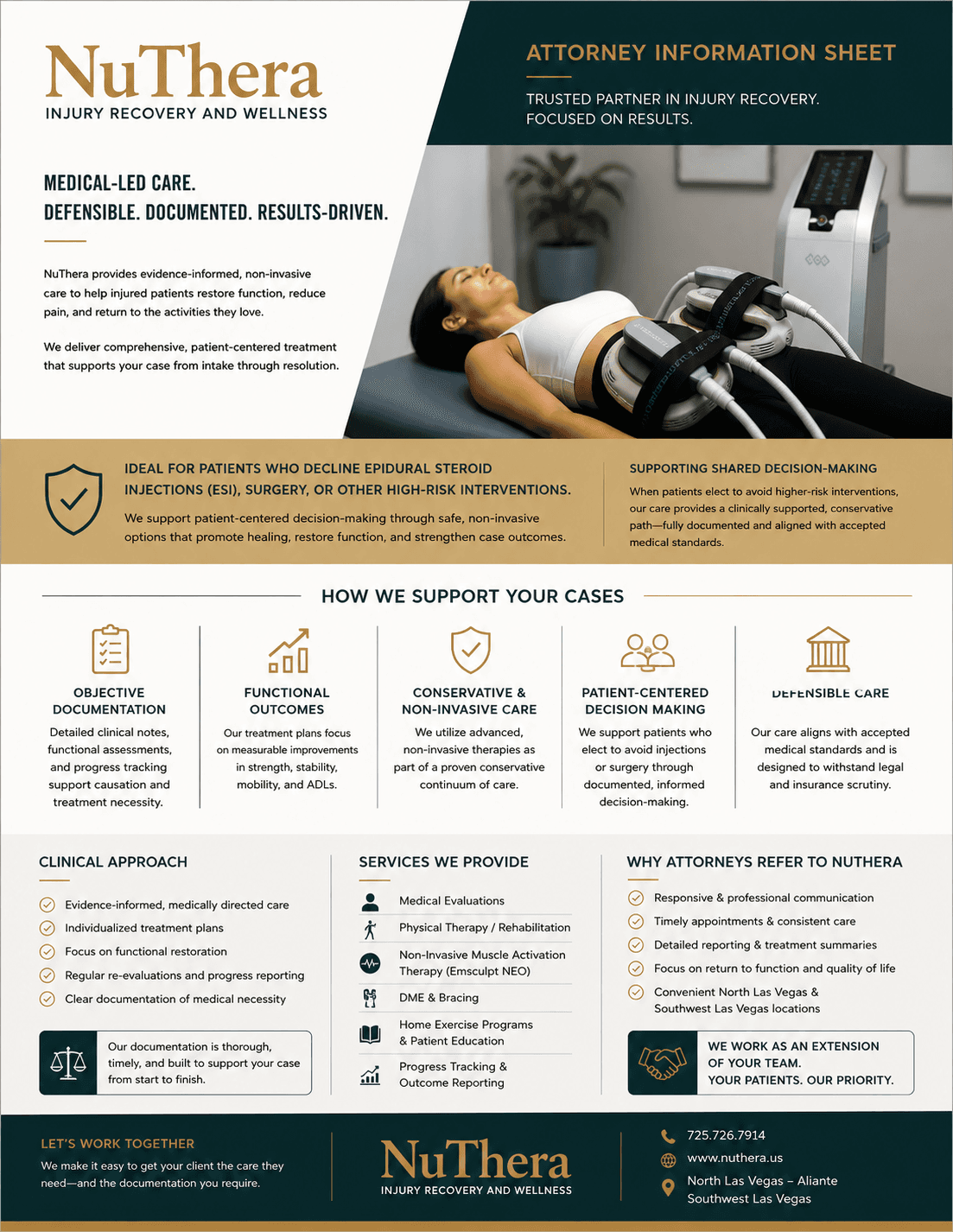
Patient receiving non-injection neuromuscular rehabilitation under physician supervision at NuThera.
EmSculpt Neo at NuThera is a non-injection, non-surgical rehabilitation modality combining HIFEM (high-intensity focused electromagnetic) energy with synchronized radiofrequency. FDA-cleared in October 2024 specifically for neuromuscular rehabilitation in arms and legs — including muscle re-education, prevention of disuse atrophy, relaxation of muscle spasms, increasing local circulation, and increasing range of motion. Treatment is physician-supervised; this is not a body contouring or aesthetic service.
What this is
- • Medical rehabilitation modality
- • Conservative care alternative to injections / surgery
- • Documentation-driven for case files
- • Physician-supervised every session
What this isn't
- • Body contouring or sculpting
- • Aesthetic / cosmetic treatment
- • A wellness-spa service
- • Fat reduction or weight-loss therapy
HIFEM + radiofrequency, applied as rehab medicine.
High-intensity focused electromagnetic (HIFEM) energy induces supramaximal muscle contractions — far stronger than voluntary effort — that re-engage motor units in deconditioned, spasming, or atrophied muscle. Synchronized radiofrequency raises tissue temperature, improving local circulation and tissue extensibility.
Clinically, this delivers what conservative PT alone cannot: rapid neuromuscular re-education in patients who can't tolerate voluntary loading because of pain, fear-avoidance, or post-surgical restrictions. The October 2024 FDA clearance expansion explicitly authorizes the device for neuromuscular rehabilitation in arms and legs — including muscle re-education, prevention of disuse atrophy, relaxation of muscle spasms, increasing local circulation, and increasing range of motion.
Clinical scenarios.
Refer a personal injury, workplace, or post-surgical patient when conservative care is appropriate but standard PT alone isn't restoring function.
MVA / soft-tissue injury
Lumbar strain or extremity injury with documented muscle spasm or weakness.
Failed conservative PT
Plateaued patients still in pain after 4–6 weeks of standard physical therapy.
Informed refusal of ESI / surgery
Patient declines injection or operative options after shared decision-making.
Pre-surgical optimization
Strengthen core stabilizers before lumbar spine or extremity surgery.
Post-surgical rehab
Rebuild atrophied muscles after immobilization or surgical intervention.
Lumbar radiculopathy with weakness
Documented motor deficit needing neuromuscular re-education.
Workplace / OWCP cases
Conservative care documentation strengthens the federal claim file.
Five anatomical zones, injury-specific.
The treating physician selects target zones based on injury mechanism, exam findings, and rehabilitation goals — not a cosmetic protocol.
Abdominal / anterior core
Reactivates core stabilizers that support the lumbar spine — central to recovery from low-back injury, deconditioning, or post-surgical inactivity.
Lumbar paraspinals
Targets the deep paraspinal musculature for patients with lumbar strain, radiculopathy with motor deficit, or chronic post-injury muscle spasm.
Bilateral arms (biceps + triceps)
Neuromuscular re-education for upper-extremity injuries, post-surgical atrophy after shoulder or elbow procedures, and chronic weakness.
Bilateral glutes / SI region
Stabilizes the pelvis and supports the lumbar chain — relevant in MVA cases, slip-and-fall injuries, and post-operative hip recovery.
Bilateral legs (quads + calves)
Rebuilds strength after immobilization, lower-extremity injury, or knee/ankle surgery. Also addresses chronic deconditioning from chronic pain.
The protocol.
Standard course is 4–8 sessions of 30 minutes each, performed over 3–4 weeks. The exact number and target zones depend on the injury and clinical findings.
30-minute sessions
Each session targets one anatomical zone.
4–8 sessions per zone
Spaced over 3–4 weeks based on clinical response.
Physician oversight
Every session under licensed physician supervision.
No anesthesia, no downtime
Patients return to normal activity immediately after each session.
We work as an extension of your team.
Lien-based billing, defensible documentation, and records turnaround built around how PI cases actually move. Your patients, your priority.
Initial evaluation report
Physician-authored, with explicit mechanism-of-injury narrative tying findings to the subject incident.
Session notes with objective measurements
ROM, pain scores, functional progress documented at every visit. No subjective-only narrative.
Causation language
Treatment necessity tied directly to the subject incident — written to defend lien at negotiation.
Informed-refusal record
Shared decision-making documented to counter failure-to-mitigate claims when ESI or surgery is declined.
Itemized superbill
Diagnosis-linked, defensible at lien negotiation, billed under standard physical medicine and rehabilitation framework.
Records turnaround
Subpoena-ready records released within 24–48 hours of request. Same-day confirmation on referrals.
Billing & lien terms
- Lien-based billing — no upfront cost to patient; attorney protected
- Standard rehab framework — billed under physical medicine and rehabilitation
- Reasonable & customary rates — see the NuThera Provider Fee Schedule
- Reduction discussions — we negotiate in good faith at settlement
- LOP-friendly — Letters of Protection accepted from established firms
One-page printable summary — when to refer, ICD-10 alignment, billing terms, target zones, and intake details. Built for lunch-and-learns and case-file documentation.
Common ICD-10 alignment.
EmSculpt Neo neuromuscular rehabilitation pairs cleanly with the following diagnosis codes commonly seen in PI, MVA, OWCP, and post-surgical cases. Treating physicians select codes based on individual clinical findings.
| Code | Description |
|---|---|
| M62.838 | Other muscle spasm |
| M54.50 | Low back pain, unspecified |
| M54.16 | Lumbar radiculopathy |
| S33.5XXA | Lumbar sprain, initial encounter |
| M25.519 | Pain in unspecified shoulder |
| M79.603 | Pain in arm, unspecified |
| M79.606 | Pain in leg, unspecified |
| M79.10 | Myalgia, unspecified site |
| M62.81 | Muscle weakness (generalized) |
| M62.50 | Muscle wasting and atrophy |
| Z47.89 | Encounter for orthopedic aftercare |
This list is representative — not exhaustive. Final diagnosis coding follows the treating physician's clinical judgment per patient.
EmSculpt Neo questions, answered.
Is EmSculpt Neo a body contouring or aesthetic treatment?
No. NuThera uses EmSculpt Neo strictly for medical neuromuscular rehabilitation under physician oversight. The October 2024 FDA clearance expansion specifically authorizes the device for rehabilitative use — muscle re-education, prevention of disuse atrophy, relaxation of muscle spasms, increasing local circulation, and increasing range of motion. We do not market or use it as a body sculpting service.
When should an attorney refer a patient to NuThera for EmSculpt Neo?
Refer when your client has muscle spasm or weakness from a soft-tissue MVA injury, lumbar radiculopathy with motor deficit, plateaued progress after 4–6 weeks of standard PT, post-surgical atrophy, or has declined ESI / surgery after shared decision-making. The treatment generates strong conservative-care documentation for the case file.
How is EmSculpt Neo billed for personal injury cases?
Lien-based billing — no upfront cost to the patient. We accept Letters of Protection (LOPs) from established firms and bill at reasonable and customary rates under the standard physical medicine and rehabilitation framework. We negotiate reductions in good faith at settlement.
What documentation does the attorney receive?
An initial evaluation report (physician-authored, with mechanism-of-injury narrative), session notes with objective measurements (ROM, pain, functional progress), causation language tying treatment necessity to the subject incident, an itemized superbill with diagnosis codes, and an informed-refusal record where applicable. Subpoena-ready records are released within 24–48 hours.
What's the treatment protocol?
Standard protocol is 4–8 sessions of 30 minutes each, performed over 3–4 weeks. The exact number and target zones depend on the injury and clinical findings. No anesthesia, no downtime — patients tolerate the protocol well and complete the full course.
Which body areas can be treated?
Five primary zones: arms (biceps + triceps), abdominal / anterior core (which supports the lumbar spine), lumbar paraspinals, glutes / SI region, and legs (quads + calves). The treating physician selects target zones based on injury mechanism and clinical findings.
How quickly can a referred patient be seen?
New patient intake — in-person at either Las Vegas location or via telemed initial consult — is scheduled within 24–48 hours of referral. Fax LOPs and referrals to the front office; we provide same-day confirmation.
Same-day confirmation. 24–48 hour intake.
Fax LOPs and referrals to the front office. Telemed initial consults available. Multilingual support: English, Spanish, and Tagalog.
Las Vegas, NV 89118
North Las Vegas, NV 89031