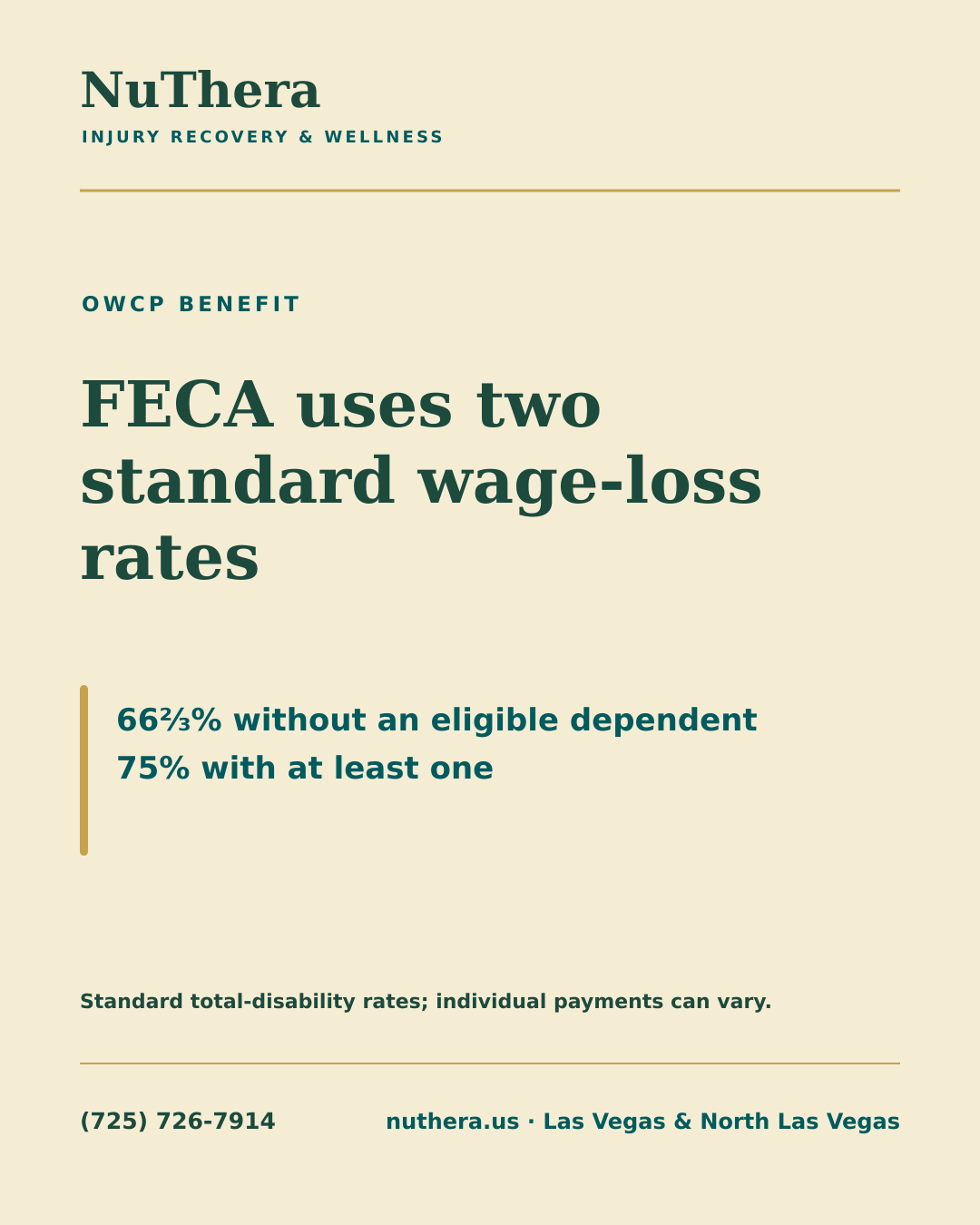
If your accepted federal work injury keeps you off the job, OWCP pays wage-loss compensation at 66⅔% of your pay rate with no eligible dependents, or 75% with at least one eligible dependent. That compensation is not subject to federal income tax, which is why 75% often feels close to your old take-home pay. It's based on your salary rate at the time of injury — not overtime — and you claim it by filing Form CA-7 through ECOMP once you're in a loss-of-pay status.
The two OWCP pay rates: 66⅔% vs 75%
FECA sets exactly two compensation rates, and which one you receive depends on a single question: do you have at least one eligible dependent?
| Your situation | Compensation rate | On a $1,000/week pay rate |
|---|---|---|
| No eligible dependents | 66⅔% of pay rate | $666.67 per week |
| At least one eligible dependent | 75% of pay rate | $750.00 per week |
One dependent is enough to reach the 75% rate — there is no additional increase for a second, third, or fourth dependent. Eligible dependents generally include a spouse, unmarried children under 18, unmarried children under 23 enrolled full-time in school, and wholly dependent children of any age who are physically or mentally incapable of self-support.
FECA wage-loss compensation is not subject to federal income tax. Your regular salary was taxed; this is not. So 75% of your gross pay rate, untaxed, often lands close to what you were actually taking home after withholding.
Why "pay rate" matters more than you think
OWCP does not calculate compensation from what you earned last year. It calculates from your pay rate at the time of injury — and the definition is narrower than most federal workers expect.
- Included: your base salary or hourly rate at the date of injury (or the date disability began, for occupational disease claims).
- Excluded: overtime. This is the single biggest source of surprise. If a substantial share of your income came from overtime, your compensation will be noticeably lower than your usual paycheck.
- Sometimes included: certain premium pay — night differential, Sunday premium, hazard pay, and similar — may count in limited circumstances depending on how regularly it was earned.
- Also relevant: if you worked less than a full year in the position, OWCP has alternative methods for determining a fair pay rate.
If you believe your pay rate was calculated incorrectly, you can request that OWCP recalculate it. Provide SF-50s, earnings statements, and documentation of any regularly-earned premium pay.
How it starts: COP first, then CA-7
For a traumatic injury, wage replacement usually arrives in two stages — and the two are taxed differently, which trips people up.
- Continuation of Pay (COP) — up to 45 calendar days of your regular salary, paid by your agency, for traumatic injuries reported on a CA-1 within 30 days. This is your normal salary and it IS taxed like normal salary.
- OWCP wage-loss compensation — begins after COP is exhausted (or from the start of lost time for occupational disease claims filed on a CA-2, which are not COP-eligible). This is the 66⅔% / 75% benefit, and it is NOT taxed.
- The 3-day waiting period — after COP ends, FECA imposes a three-day waiting period before compensation begins. If disability continues beyond 14 days, those three days are paid retroactively.
Do not wait until day 45. Submit Form CA-7 through ECOMP around day 30 to 40 so OWCP has time to process it before your agency stops paying. Filing late is one of the most common reasons federal workers see a gap with no income at all.
When and how you actually get paid
- Form CA-7 — the claim for compensation. File it through ECOMP with supporting medical evidence for the period claimed.
- Form CA-7a — the time-analysis attachment for intermittent lost time. Use it when you missed scattered days or partial days rather than a continuous block.
- Direct deposit — submit Form SF-1199a so payments reach your bank account instead of arriving by mail.
- Periodic rolls — once you are on continuing disability, OWCP generally pays on periodic rolls approximately every 28 days rather than per-claim.
- Tracking — you can check case and payment status through ECOMP and the Central Query System (CQS).
The #1 reason checks are late or denied
It is almost never the form. It is the medical evidence attached to it.
A CA-7 claims a specific period of disability. OWCP will only pay for days its file supports medically. If your physician's documentation does not cover the exact dates claimed — or does not clearly state that you were unable to work due to the accepted condition — those days get denied even when the underlying claim is accepted and your paperwork is otherwise perfect.
- Make sure your treating physician's notes cover every date range on the CA-7.
- The documentation must tie the disability to the accepted condition specifically — not to an unrelated or unaccepted diagnosis.
- Work restrictions should be current. A CA-17 duty status report that is months stale will not support a present claim.
- If OWCP requests additional development, respond quickly — every round trip adds weeks to payment.
Your claims examiner is not going to call your doctor for you. A provider who knows FECA documentation writes notes that match the periods you're claiming, keeps CA-17s current, and responds to development requests without being chased — which is the difference between getting paid on schedule and waiting months.
Wage-loss compensation vs. schedule awards
These are two separate benefits and they answer two different questions. Wage-loss compensation replaces income while you cannot work. A schedule award compensates you for permanent impairment to a body part, and it is paid whether or not you are working — you can be back on full duty and still receive one.
You generally cannot receive both for the same period of time, but many federal workers are entitled to wage-loss compensation during recovery and then a schedule award once they reach Maximum Medical Improvement.
Getting your documentation right in Las Vegas
NuThera is an OWCP-enrolled practice treating injured federal workers across the Las Vegas Valley. We write the medical documentation CA-7 claims depend on — notes that match the periods being claimed, current CA-17 duty status reports, and prompt responses when OWCP asks for development. Two locations:
- Las Vegas (Rainbow / Spring Valley): 5765 S Rainbow Blvd, Ste 111, Las Vegas, NV 89118-2537
- North Las Vegas (Aliante): 3880 W Ann Rd #130, North Las Vegas, NV 89031
Call (725) 726-7914 or request an appointment online. We'll review whether your medical documentation actually supports the period you claimed — that's usually where the hold-up is.
Keep exploring.
- OWCP Continuation of Pay & Form CA-7
The process companion to this piece — what COP is, how the 45-day window works, and exactly when to file your CA-7.
- OWCP Overview
How NuThera supports federal workers through the full claim lifecycle — filing, treatment, documentation, and impairment rating.
- Filing an OWCP claim (CA-1 / CA-2)
The claim that has to be accepted before any wage-loss compensation can be paid.
- OWCP Forms library
CA-7, CA-7a, CA-17, SF-1199a and every other form referenced in this guide, with official DOL links.
- OWCP claim denied? What to do next
If the underlying claim is denied, no wage-loss compensation is payable — start here.
- OWCP schedule awards explained
The separate permanent-impairment benefit — paid whether or not you're back at work.
Common questions.
How much does OWCP pay per week?
66⅔% of your weekly pay rate with no eligible dependents, or 75% with at least one eligible dependent. On a $1,000 per week pay rate that's $666.67 versus $750.00 — and both amounts are exempt from federal income tax.
Is OWCP wage-loss compensation taxable?
No. FECA wage-loss compensation is not subject to federal income tax. Continuation of Pay (COP) is different — that is your regular salary paid by your agency and it is taxed normally.
Does OWCP pay 75% or 66⅔%?
It depends on dependents. You receive 75% with at least one eligible dependent and 66⅔% with none. A single eligible dependent is enough to reach the 75% rate; there is no further increase for additional dependents.
Is overtime included in my OWCP pay rate?
Generally no. Compensation is based on your salary or pay rate at the time of injury, and overtime is excluded. Certain premium pay — night differential, Sunday premium, hazard pay — may be included in limited circumstances depending on how regularly it was earned.
How do I claim OWCP wage-loss compensation?
File Form CA-7 through ECOMP with medical documentation supporting the period claimed. Use Form CA-7a for intermittent or partial lost days. For traumatic injuries, file before your 45 days of Continuation of Pay run out — around day 30 to 40 — so there's no gap in income.
When will I get my first OWCP check?
After your claim is accepted and OWCP processes a CA-7 supported by medical evidence. For traumatic injuries there is a three-day waiting period once COP ends, though those days are paid retroactively if disability continues beyond 14 days. Ongoing disability is generally paid on periodic rolls roughly every 28 days.
Why is my OWCP payment less than I expected?
Usually one of three things: your compensation is calculated on base salary only and excludes overtime; you have no qualifying dependent on file so you're at the 66⅔% rate rather than 75%; or your medical documentation didn't support all the days you claimed on the CA-7.